Sunday
One full week of fatigue. Am so tired it’s an effort to drag myself out of bed.
Flew missions on the 9th1 and the 11th,2 number 19 and 20. 30 more to go and we can go home to the good old United States and my good, good wife. Only 8 more months to go.
Have received a dozen letters and written as many if not more. Everyone’s good about writing. Have been very lonesome all week and nerves a little on edge.
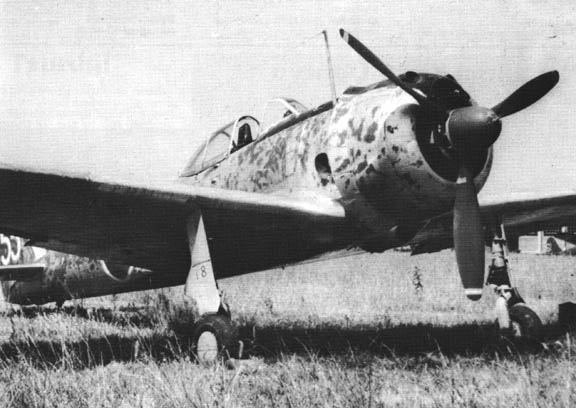
Nakajima_Ki-43-II
Oscar
from Wikipedia
Yesterday, two Japanese Oscars3 were seen as well as several grounded on Rapopo airdrome4. So we had a fighter escort this morning. TBFs also hit target today as did Lightnings, P-38s. Slow weeks to be sure.
Now for the sack if I can get these Poker players off my sack.
Notes & Commentary
1 The 75th Bombardment Squadron was tasked with bombing Rabaul on June 9 from a medium altitude with 100 lb. general purpose bombs at 1040L.
The mission aircraft took off from Stirling Island from 0845 to 0851L and were over the target at 1045L. The mission dropped 144 bombs in the target area. Two fires with dirty yellow to black smoke which rose to 300 ft or more were started in the target area. One smaller but more prominent column of smoke was also noted. Aircraft 112 had one bomb fall out unexpectedly when its bomb bay doors opened.
All 12 mission aircraft recovered at Stirling between 1225 and 1232L.
No enemy aircraft intercepted the mission. Two 75 ft. barges, stationary in the water between “The Beehives” and the west shore of Simpson Harbor were observed during the mission. Keravat Airdrome appeared serviceable and the damaged Betty had been removed from the north end of the strip. The current in St. George Channel was flowing at 5 kts.
Mission Report, Mission No. 150, 9 June 1944, 75th Bombardment Squadron (M). Office of the Intelligence Officer, 9 June 1944, microfilm A0565, Maxwell AFB, AL: Air Force Historical Research Agency, 1973, frames 766-767.
Missions were far more complicated than is apparent from that described above for the 75th Bombardment Squadron. That was just the 75th Bombardment Squadron’s portion of a larger operation involving US Navy and Marine Corps bomber and fighter aircraft as well as another B-25 squadron from the USAAF’s 42nd Bombardment Group.
While on 9 June the 75th Bombardment Squadron was tasked with being over the target at 1040L, the actual attack was scheduled to begin at 1000L:
At 1000L, PBJs (the Navy version of the B-25) flown by US Marine Corps Bombing Squadron VMB-423, then operating out of Stirling Island, attacked Rabaul. At 1020L, Navy/USMC fighters bombed Talili airfiled at 1020L. Throughout the strike, Four Navy/USMC fighters provided coverage over the target.
At 1040L, 12 B-25s from the 75th Bombardment Squadron bombed Rabaul targets. This was followed at 1050L by bombing by 12 B-25s from the 69th Bombardment Squadron. Altogether, these two squadrons dropped 288 general-purpose, 100 lb bombs on their targets.
Such coordinated strikes were common and required extensive coordination as to flight routes, communications procedures regarding frequency usage and call signs, IFF (identification friend or foe) signals, friendly shipping positions, and rescue aircraft to name just a few items.
Flight Order 335, Headquarters 42nd Bombardment Group (M), 8 JUNE 1944, microfilm B0131, Maxwell AFB, AL: Air Force Historical Research Agency, 1973, frames 1745-1746.
2 On 11 June 1944, Rabaul antiaircraft positions were attacked by 75th Bombardment Squadron B-25s.
The 12 mission aircraft launched between 0832 and 0838L. At 0930L, aircraft 645 piloted by 1st Lt. Scruggs, returned to base due to engine trouble. Aircraft 108 piloted by 1st Lt. Forand toggled its bombs at Cape St. George when they wouldn’t release over the target. It is likely that Wayne was a member of this aircraft’s crew.
Escort for the mission was provided by at least six fighters which were observed by the mission aircraft.
General purpose 100 lb. bombs were dropped from medium altitude. Three small fires adjacent to the northerly gun positions and two just east of the southerly positions were observed all emitted dark gray smoke 50 to 100 ft. high. Two large fires were started immediately north of the radar station at Cape St. George. One of these fires emitted dirty yellow smoke and the other black smoke all rising to about 500 feet and visible from 30 miles away.
At Rapopo Airfield six aircraft were noted in the northwest revetments one of which was possibly a silver Betty. Eight possible twin-engine aircraft were observed in the southwest revetments. The runway appeared unserviceable.
Mission Report, Mission No. 151, 11 June 1944. 75th Bombardment Squadron (M). Office of the Intelligence Officer, 11 June 1944, microfilm A0565, Maxwell AFB, AL: Air Force Historical Research Agency, 1973, frames 768-769.
3 Oscar was the Allied codename for the Nakajima Ki-43 Hayabusa (Peregrine Falcon) used by the Imperial Japanese Army Air Force. See http://en.wikipedia.org/wiki/Nakajima_Ki-43. Although heavily attacked, the Japanese appear to have salvaged parts from more severely damaged aircraft to keep some aircraft in service. Among these is the re-built Nakajima Ki-43 Hayabusa salvaged from Rabaul, New Britain and currently held by the Flying Heritage Collection in Everett, Washington. See http://www.flyingheritage.com/TemplatePlane.aspx?contentId=21.
In June 1944, Rabaul-based fighter aircraft were still present and the Japanese were capable of mounting a minimal defense. One mission of USMC VMB-423 was to maintain an aircraft on station over the Rabaul area during night time hours. This aircraft dropped bombs on any lights seen and monitored, using its airborne radar, any ship or aircraft movement. On 9 June 1944, the VMB-423 aircraft on station was attacked by two A6M Zeroes. Scutts, Jerry. PBJ Mitchell Units of the Pacific War. London: Osprey Publishing Ltd., 2003. pp. 22-23.
4 Rapopo Airfield was located southeast of Rabaul. The airfield’s antiaircraft defenses were attacked by 12 B-25s, 20 P-39s, and 20+ US Navy dive bombers on 10 June and by 130+ B-25s, P-38s P-39s and USN dive bombers pounded its antiaircraft positions on 11 June. On 12 June, B-24s bombed the runway at Rapopo.
American missions against Rapopo and Rapopo Airfield, January 26, 1943 – June 23, 1944. PacificWrecks.com (http://pacificwrecks.com/airfields/png/rapopo/missions-rapopo.html : accessed 9 June 2014)


