Wednesday
Wayne made no entry in his journal on this day.
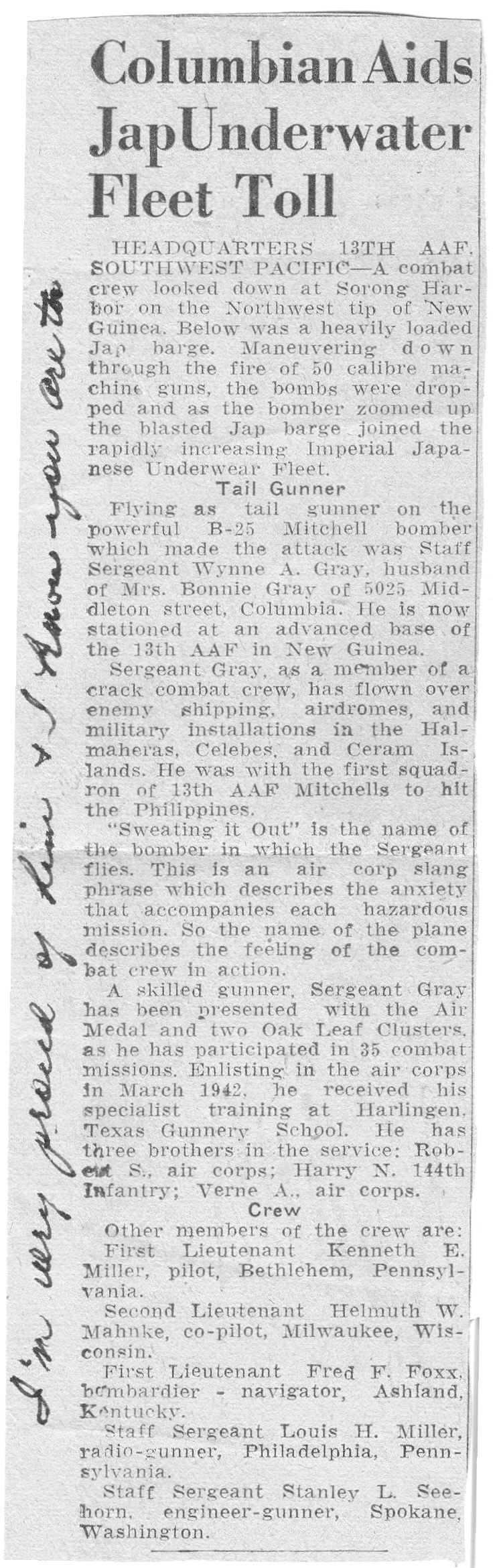 On November 1, 1944, Wayne flew on a 2½ hour, two-plane shipping sweep to the Sorong-Cape Noejew area. The mission had orders to hit any available targets of opportunity. He flew on B-25J #013 piloted by 1st Lt. Kenneth E. Miller. Also on the plane were 2nd Lt. H. W. Mahnke, 2nd Lt. Ralph Stem, Pvt. C. Lambert, and Wayne’s close friend, S/Sgt. Stanley L. Seehorn. The second B-25J, plane #015, was piloted by 1st Lt. O. G. Emery. The crew of #015 consisted of 1st Lt. W. D. Newlon, 1st Lt. Lutes, Cpl. G. L. Winkler, S/Sgt J. L. Thurston, and Sgt. James R. Higgins, one of Wayne’s tent mates.
According to the final mission report1 and the narrative combat report2, the mission aircraft departed Mar Air Field at 1135 and 1140. Each aircraft carried four 500 lb. general purpose bombs plus a full load of .50 caliber machine gun ammunition.
Less than a hour after takeoff, the mission found one SC craft3 and three type “A” (Army) Japanese landing craft4 anchored in a small bay 1½ miles southeast of Cape Noejew. Two attacks were made from an altitude of 60 feet. Lt. Miller’s attack was at 1215 which was followed by Lt. Emery’s attack at 1224. Lt. Miller dropped four 500 pound general-purpose bombs. One scored a direct hit, disintegrating one of the landing craft with the others walking northerly close to the shore with no observed results. Lt. Miller also strafed the SC vessel as well and the landing craft. Lt. Emery strafed the three landing craft, two of which were thoroughly riddled while the third was observed to have been hit.
At 1245 during a run along the southeast coast to Cape Noejew, Lt. Emery came upon and strafed six small barges. His tail gunner shot a Jap running toward land on a jetty. Two other jetties were strafed as well. He started what appeared to be and oil fire as thick as black smoke rose to 500 feet. At 1300, Lt. Miller strafed the same six barges strafed by Lt. Emery. Both attacks were made at an altitude of 60 feet. Difficulty was encountered in making approaches because of the uneven terrain east of Cape Noejew and the location of enemy gun positions.
In the course of the four attacks, Lt. Miller dropped four 500 lb. general-purpose bombs and expended approximately 2,000 rounds of ammunition. Lt. Emery dropped no bombs but expended 3,500 rounds of ammunition.
Heavy and accurate antiaircraft artillery fire coming from Cape Noejew was felt during these attacks. Lt. Emery’s plane picked up three hits, one in the nose and two in the tail.
The mission aircraft recovered at Marr airfield at 1350 and 1352 respectively
Notes & Commentary
1 Final Mission Report, Mission No. 140, 1 November 1944, 100th Bombardment Squadron (M). Office of the Intelligence Officer, 1 November 1944, microfilm A0576, Maxwell AFB, AL: Air Force Historical Research Agency, 1972, frames 1612-1613.
2 Narrative Combat Report, 1 November 1944, 100th Bombardment Squadron (M). Office of the Intelligence Officer, 1 November 1944, microfilm A0576, Maxwell AFB, AL: Air Force Historical Research Agency, 1972, frame 1611.
3 For information regarding Imperial Japanese Navy SC-class vessels, see “No.1-class auxiliary submarine chaser.” Wikipedia. (http://en.wikipedia.org/wiki/No.1-class_auxiliary_submarine_chaser : accessed 31 October 2014).
4 The “barges” attacked were most likely Daihatsu Class Japanese landing craft which played a significant logistical role in the South Pacific. It is reported that 85% of all Japanese landing craft were of this type. “Daihatsu Class, Japanese Landing Craft.” The Pacific War Online Encyclopedia. (http://pwencycl.kgbudge.com/D/a/Daihatsu_class.htm : accessed 31 October 2014)


